
How China Built Quiet Global Power: Rare Earths, Technology, and Geopolitics
 By Super Admin
- Leadership
- Jan 13, 2026
- 3 minutes read
- 715 Views
How China quietly gained global power by controlling rare earths, making the world’s biggest tech companies dependent on its supply chain.
Until the 1970s, global power was measured mainly by military strength. The country with more tanks, more warships, and bigger armies was considered a superpower. But from the 1980s onward, the world began to change. Computers, electronics, and modern technology started to shape power in new ways. It was during this period that China began making a long-term calculation—one that very few countries took seriously at the time.
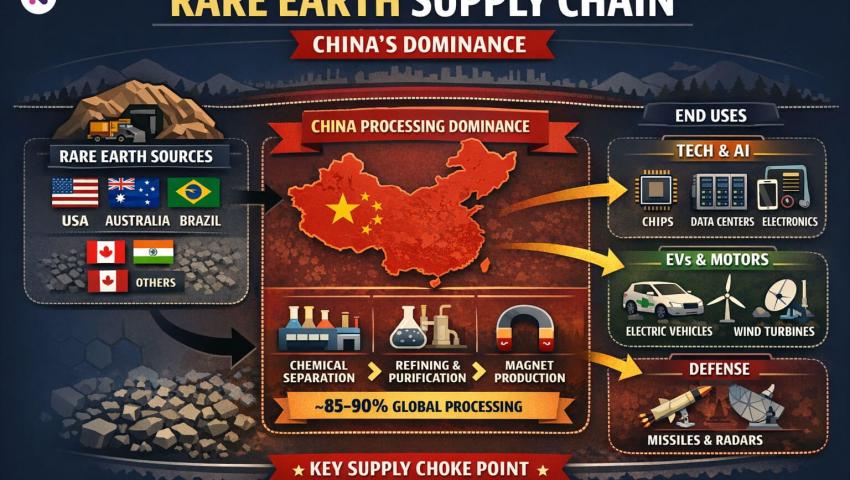
By the late 1980s, China realized that the future world would run on technology: computers, chips, electric machines, and later, artificial intelligence. Hidden deep inside these technologies are certain special materials known as rare earth elements. They are not truly rare, but separating and refining them into usable form is extremely complex and harmful to the environment.
During the 1990s, many countries in the United States, Europe, and Japan began prioritizing environmental protection. They understood that rare earth processing could cause long-term damage to soil, water, and human health. Fearing environmental degradation, these advanced nations gradually stepped away from this industry. Many facilities were shut down, and several projects were abandoned.
China chose a different path. Throughout the 1990s, it invested heavily in rare earth mining, refining facilities, and research. Even while understanding the environmental risks, China continued forward because its goal was long-term control. Around that time, a Chinese leader famously said, “The Middle East has oil, China has rare earths.” History would later prove this statement to be true.
In the 2000s, China slowly became the global center for rare earth supply. Raw materials mined in different countries were increasingly sent to China for processing and refinement. During this decade, China took control of a large share of the world’s rare earth processing capacity.
In the 2010s, global demand for technology surged. Smartphones, cloud computing, data centers, and electric vehicles expanded rapidly. Apple needed advanced components for its phones and computers. AMD and NVIDIA required powerful chips. Microsoft depended on massive data centers. Intel pushed forward with advanced manufacturing. Behind all of these industries, directly or indirectly, rare earth materials played a critical role.
It became clear during this decade that the world’s largest technology companies were dependent on China—whether they intended to be or not. Some produced chips, others software or servers, but inside motors, cooling systems, power units, and manufacturing tools were materials whose supply routes China controlled.
By the 2020s, the rise of artificial intelligence, large-scale data centers, and modern military technology deepened this dependence even further. A delay in supply or a disruption in processing could affect projects worldwide. China rarely issues direct threats. Instead, through regulations, permits, and procedural control, it quietly demonstrates how sensitive global supply chains truly are.
This is why today many countries speak to China with caution. It is not about admiration or ideology—it is about calculation. Governments understand that strained relations with China can mean more than diplomatic tension; they can disrupt technology, industry, and long-term planning.
China does not rule the world through war. It rules through patience, time, and control over essential pathways. When everyone must eventually walk the same road, the one who holds the key to that road ultimately commands attention.
This is China’s quiet power—built over decades.
Super Admin
Leave a comment
Your email address will not be published. Required fields are marked *